How Do I Know If I Have a Long Torso?
How Do I Know If I Have a Long Torso? (And What Swimsuits Actually Work)
If one-piece swimsuits regularly feel like they’re pulling down at the shoulders and riding up where you don’t want them to, it’s not a “you problem.” It’s just about getting proportion right. A long torso is simply a body ratio where your upper body (the length from shoulders to crotch) is longer than average relative to your total height. That ratio can show up at any height, including petite.
Torso proportions vs. height: the 3 big myths
Myth 1: You have to be tall to have a long torso.
Not true. Petite women can also discover they need long-torso-friendly construction because their height is concentrated in their torso, not their legs.
Myth 2: Long torso is the same as “long-waisted.”
Not always. “Long-waisted” refers to the distance between the underbust and your natural waist. A long torso can also show up as a long rise (waist-to-crotch). You can have one without the other, and swimsuits are affected by both.
Myth 3: One-pieces aren’t for you.
One-pieces can work beautifully with the right length strategy. It’s about construction and adjustability, not avoiding an entire category.
How to tell if you have a long torso: 3 diagnostic methods
Wondering if you officially have a long torso? Here are a couple of methods to measure and find out.
Method 1: The hand test (a quick check)
Stand naturally and stack your hands horizontally beneath your bust down toward your waist. If you can fit more than about two hand widths in that space, you may be long-waisted, which often correlates with long-torso fit challenges. (Disclaimer: Use this as a quick indicator, not a final verdict. Hand size varies, and bust placement can shift the “starting point.”)
Method 2: The sitting height ratio (accuracy play)
This is the most objective option. The “sitting height ratio” is actually a real anthropometric measurement used in science.
- Sit tall on a flat surface with your back straight.
- Measure from the surface you’re sitting on to the top of your head (sitting height).
- Divide that by your total height.
If your sitting height ÷ total height ≥ 0.56, that strongly indicates a long torso proportion. The 0.56 cutoff for a “long torso” is not a standard medical rule—it’s usually a simplified interpretation used in fitness, tailoring, or online body-proportion guides.
Method 3: The swimsuit measurement (torso loop)
If swimsuits are your pain point, then let’s measure against the suits.
The torso loop method involves running a flexible tape from the top of one shoulder, down through your legs, and back up to the same shoulder point. That number is your “torso loop.” Now, measure a one-piece to see if it extends that length. If you’re consistently above many standard swim sizing ranges, you’ll do better in long-torso/tall constructions rather than sizing up and hoping for the best. (If you find yourself sizing up only to get length, and then battling gaping sides or loose leg openings, that’s your sign to switch to long-torso construction instead of upsizing.)
Common misreads: long torso vs. high hips vs. short legs
A long torso can be confused with high hips (where the hip line sits higher) or shorter legs. Another good clue is the sitting test: if you seem taller than friends when seated, but similar when standing, your height is likely concentrated in your torso.
Why it matters: if the real issue is high hips, you might need different bottom cuts. If it’s short legs + long torso, you’ll want styles that visually lengthen the leg line while giving you enough torso length.
Fitting room checklist: try this before you buy
A long torso may cause fit issues when you test a new swimsuit with different movements.
Do this quick check: raise your arms overhead like you’re reaching for something. If the suit yanks aggressively, pulls into a wedgie, or drags the bust down, it’s too short through the torso.
Swimsuit fit failures and what they mean
When a suit is too short through the torso, your body will borrow length from wherever it can. That’s when fit issues show up.
- Shoulder straps digging in: likely the suit’s torso length is too short and being stretched to accommodate your frame.
- Bust area sitting too low or feeling unstable: vertical stretch is pulling the suit downward, changing where the bust should sit.
- Constant front wedgie: usually a rise/torso loop issue; the suit is pulling upward from the crotch.
- Fuller Bust Phenomenon: A fuller bust requires more vertical fabric in a one-piece, which can make the suit feel effectively shorter through the torso. If you’re a D+ cup, you may need long-torso features even if your overall proportions are balanced.
Swimsuits that actually work for a long torso
You don’t need to settle for suits that don’t fit quite right. Look for long-torso-friendly construction:
- Adjustability: tie-back straps, adjustable straps, or shoulder ties can add meaningful vertical flexibility.
- Fabric with strong stretch and recovery: higher elastane/Lycra blends and four-way stretch help the suit move with you and bounce back.
And if the one-pieces aren’t doing the trick, don’t stay limited.
- Two-piece strategy: bikinis eliminate one-piece vertical tension entirely. A high-waisted bottom can also break up torso length visually.
- Longline tops and tankinis: coverage without tug.
Find current SKIMS swimwear options and adjustable styles for your body; simply start here and filter by silhouette.
Our SKIMS One-Piece Swimsuit Picks for Long Torsos
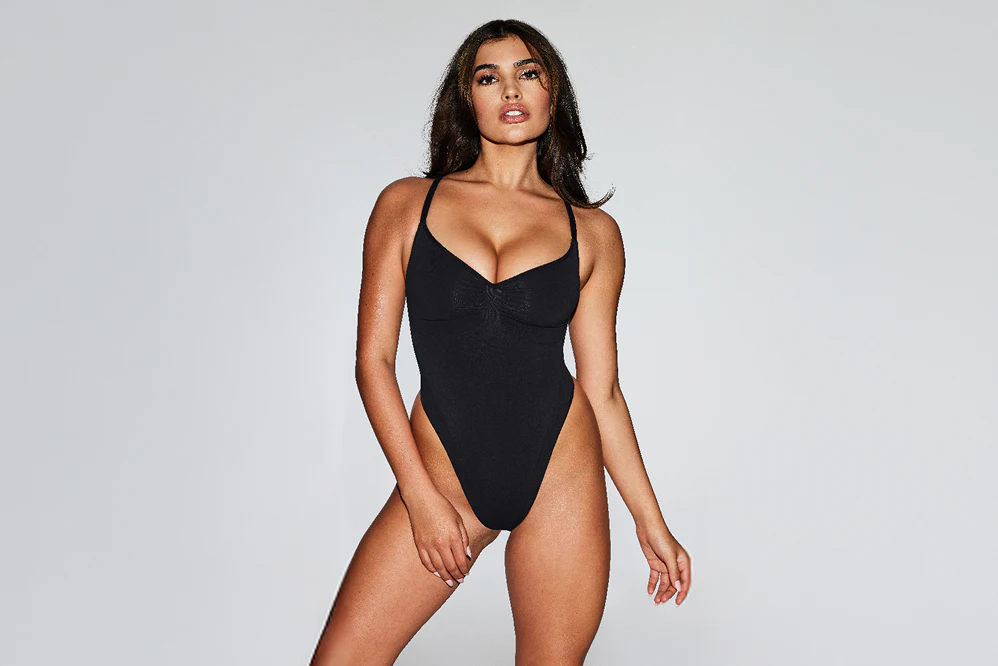
A versatile one-piece with adjustable straps and medium coverage, allowing you to accommodate length through the shoulder line, which can be especially helpful if your torso feels long in most standard one-piece cuts.
The mini-short element of this suit may help anchor the suit to your hips while it stretches to your torso. And if it’s riding up, the super-low plunge neckline allows you to adjust the suit downward without losing silhouette intention.
This works like a one-piece with the flexibility of a two-piece. The fabric positioning allowed by the cut-out allows for personalized adjustment to your torso. Want even more adjustability? Try the Plunge Monokini with tie straps in a similar silhouette.
Like its scoop neck sister, this versatile one-piece has convertible adjustable straps. Its high leg opening creates a curve against a long torso. In combo with its deep plunge neckline, this suit is designed to accentuate length.
Any swimsuits with adjustable strap features (especially on one-pieces) help mitigate fit tension in the upper body, which is often part of what makes long torsos feel shorter in standard cuts.
Still not fitting? Try branching out with bikinis
High-waisted bikini bottoms visually balance torso length, without the vertical stretch tension from a one-piece. Try the SKIMS Signature Swim High-Waisted Bikini Bottom, and pair it with a mismatched top for even more silhouette intrigue.
FAQs
Why do one-piece swimsuits always give me a wedgie?
It’s often a torso-length issue. Standard one-pieces are cut for an average torso length, so a longer torso can pull the fabric upward.
Can you have a long torso if you are short (petite)?
Yes. Proportions are relative. Many petite women need long-torso features.
How do I measure my torso for a swimsuit?
Use the torso loop method: measure from shoulder → down through legs → back to the same shoulder point. If it matches the same measurement on the actual swimsuit, then it fits.
Does a large bust mean I have a long torso?
Not necessarily, but a fuller bust can “use up” some of the fabric in a one-piece, making long-torso-friendly construction feel better and more accommodating.
Are bikinis better for long torsos?
They’re often the easiest solution because they remove the vertical tension found in a one-piece suit. High-waisted bottoms can also balance proportions.
Should I size up in a regular one-piece if I have a long torso?
You can, but it might create bagginess at the sides and leg openings. A torso-friendly cut in a high-functioning stretch fabric is usually a better fix.
What is the scientific ratio for a long torso?
The Sitting Height Ratio (sitting height ÷ total height). They say a ratio of about 0.56 or higher indicates a longer torso.